
Trash Hack Campaign
Learn about the trash hack campaign!
The global campaign “Trash Hack” encourages young people to take action to promote sustainable development, reflect on their actions, and share their learnings. While the campaign officially ran from January to March 2021 (you can watch the launch webinar here) it’s not too late to participate! You can still share your trash hacks on social media by using the hashtag #TrashHack.
For this educational campaign, FEE has partnered with the UNESCO Associated Schools Network (ASPnet) to make a global call for action and encourage schools to engage in action learning on trash, waste management and, more widely, sustainable development! Many students participating in Eco-Schools, Young Reporters for the Environment (YRE), Learning about Forests (LEAF), and especially the Litter Less Campaign, have already made important actions to reduce their waste. Now it’s time to inspire millions of others to do the same!
During this pandemic, disposable protective materials like masks and gloves have created a new stream of hazardous waste. When it comes to tackling the world’s trash, it can be hard to know where to start. But by making “hacks” or changes in our homes, schools and communities, we can reduce our negative impact, increase our understanding and start to be part of transforming the world. The global is connected to the local!
Find out more on the UNESCO Trash Hack website.
Trash Hack Ideas
Trash Hacks are easy actions to reduce waste which can lead to big ideas for the planet! Education is at the heart of the campaign, where Trash Hackers will learn about sustainability through action. These are just suggestions, so feel free to get creative!
Individual Activities:
Find ways to encourage friends, parents and teachers to pack a waste-free lunch!
Turn plastic water bottles into a hanging wall planter for a garden of any size.
Interview someone from your local landfill, city or county public works department, town’s sustainability organization, waste hauler, or department of environmental quality about the effects of waste and litter in your local community.
Research information on the supply chain of a t-shirt and create a learning poster on this topic. Produce a tote bag out of a t-shirt to learn about repurposing and upcycling!
Activities In the Classroom:
Start a compost or worm bin! Students can then experience how worms and other decomposers recycle fruits and vegetable scraps into compost and create a reportage about ecosystems and biodegration.
Conduct a classroom audit to identify waste and look for ideas to reduce and reuse. Empower the student to set goals, search for solutions and review progress
Go on a field trip. Visit your local landfill, recycling center, or a nearby composing facility where the students can see first-hand what is happening to waste, and learn about the lifecycle of waste and its effect on the environment.
Design a questionnaire and conduct interviews on food waste with personnel of the school canteen.
More ideas for Trash Hacks will be published on social media for inspiration.
Teacher’s Guide
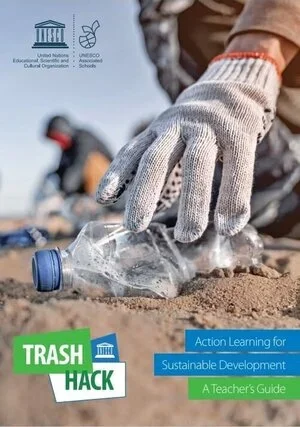
UNESCO’s Teacher’s Guide is intended for (lower-)secondary education teachers, school administrators, and staff and informal educators looking for ways to engage learners and communities around trash, waste management and, more widely, education for sustainable development. The guide’s contents and activities can be adjusted for older or younger ages.
UNESCO’s Teacher’s Guide is intended for lower and secondary education teachers, school administrators, and staff and informal educators looking for ways to engage learners and communities around trash, waste management and, more widely, education for sustainable development. The guide’s contents and activities can be adjusted for older or younger ages.
You can access the Teacher’s Guide: Here
Teacher’s Checklist: Planning for Action
Get informed! There’s lots of information and infographics in the Trash Hack Teacher’s Guide
Get inspired by the suggested activities. Adapt them to your local context, students’ ages and the current situation due to the COVID-19 pandemic. Feel encouraged to create your own activities and projects to trash hack your school.
Think about who you want to involve: your students, colleagues, school staff, parents, local politicians, local media, NGOs, associations, etc.
Define the goals you want to achieve with your Trash Hacks!


Quisque iaculis facilisis lacinia. Mauris euismod pellentesque tellus sit amet mollis.